
After Hours Answering Service AI: The 2026 Guide
David M.
CEO, Woizer
After Hours Answering Service AI: The Complete 2026 Guide
Every missed call after 5 PM is a customer choosing your competitor. Not because your service is worse — because nobody picked up the phone.
For most small businesses, the math is brutal. You close at 6. Your best prospects are Googling you at 8. They call. They get voicemail. They hang up. They call the next listing. You never even know they existed.
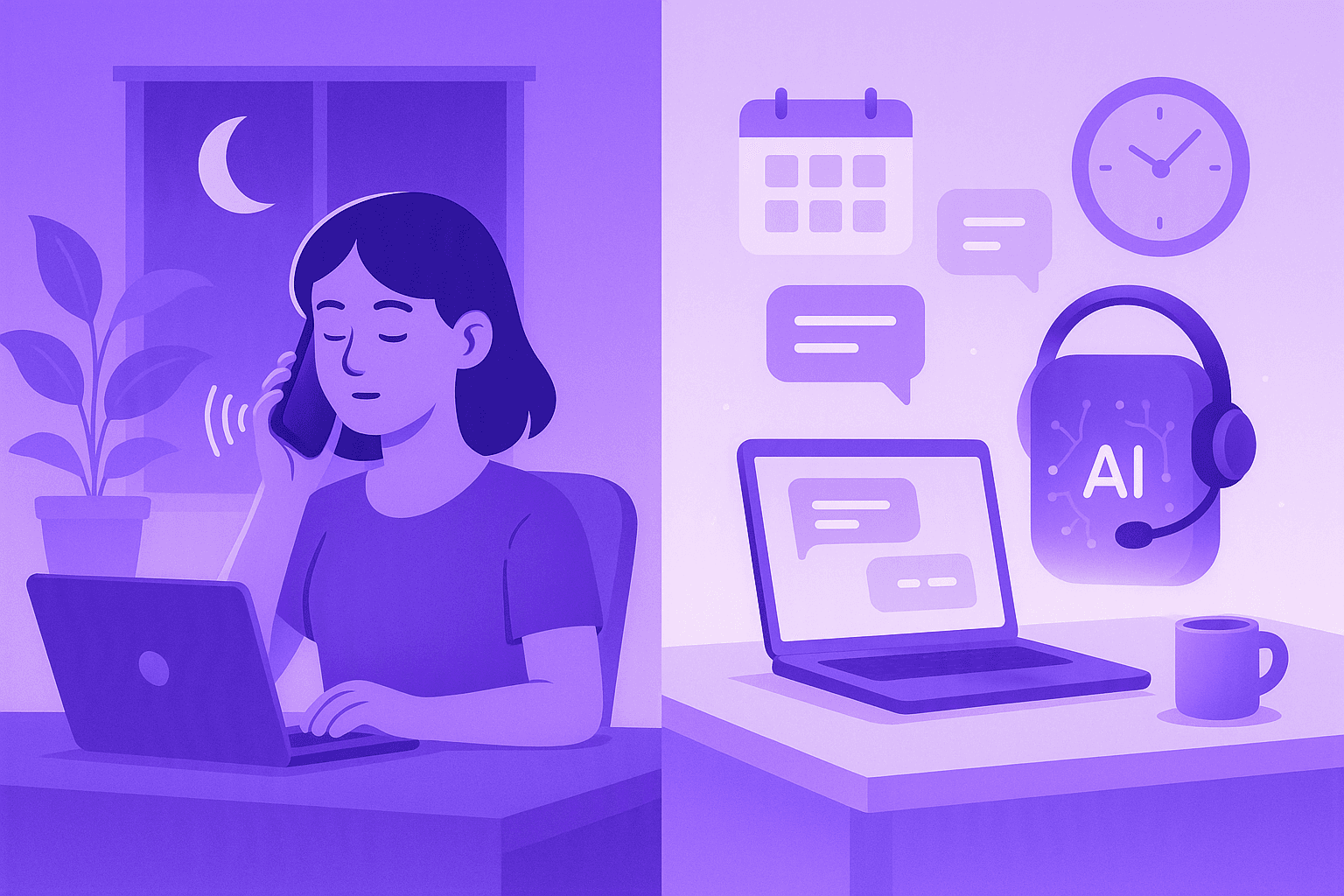
An after hours answering service AI changes that equation entirely. Instead of voicemail purgatory or expensive human answering services that fumble your specifics, an AI phone agent picks up every call, understands context, books appointments, routes emergencies, and sends follow-ups — all while you sleep.
This isn't theoretical. It's happening right now across dental offices, home service companies, veterinary clinics, and SaaS companies. Here's how it works, what it actually costs, and how to set one up in minutes.
Key Takeaways (TL;DR)
- Traditional answering services cost $200–$1,500/month and still put callers on hold, read from rigid scripts, and miss nuance. AI phone agents handle unlimited calls for a fraction of the cost.
- After hours answering service AI responds in under 500 milliseconds, speaks 30+ languages, and can book appointments, send SMS confirmations, and route urgent calls to your cell — no human operator needed.
- Setup doesn't require developers. The best AI phone agents scan your website, learn your business, and go live in minutes.
- The ROI is immediate. Capturing even 2–3 after-hours leads per week that would've gone to voicemail can pay for a full year of service.
Why Traditional After Hours Answering Services Are Failing
Let's be honest about what a traditional answering service actually delivers in 2026.
You pay a monthly fee — usually between $200 and $1,500 depending on call volume. A human operator sitting in a call center picks up your phone. They read from a script you provided two months ago (and forgot to update when you changed your hours). They take a message. They email it to you. You see it the next morning.
Here's what goes wrong:
- Callers can tell it's an answering service. The operator doesn't know your menu, your pricing, your availability. They stall. The caller loses confidence.
- No real action gets taken. Messages sit in an inbox. Urgent calls don't get routed. Appointments don't get booked.
- Per-minute billing creates anxiety. You start worrying about chatty callers driving up costs instead of focusing on conversion.
- Scalability is a wall. Holiday weekends, seasonal spikes, multiple simultaneous calls — human services buckle when you need them most.
Industry data consistently shows that the majority of callers who reach voicemail don't leave a message. They just call someone else. And callers who do leave messages? Many businesses take 24+ hours to return those calls, by which point the prospect has already hired a competitor.
Traditional answering services were a reasonable solution in 2015. In 2026, they're a leaky bucket.
How After Hours Answering Service AI Actually Works
An AI phone agent isn't a glorified voicemail tree. It's a conversational AI that understands natural language, responds in real time, and takes action.
Here's the actual flow when a customer calls your business after hours:
1. Instant pickup. The AI answers within one ring. No hold music. No "your call is important to us." Just a natural greeting — "Hi, thanks for calling [Your Business]. How can I help?"
2. Natural conversation. The caller says what they need in their own words. "I need to book a teeth cleaning for next Thursday" or "My pipe burst and I need someone tonight." The AI understands intent, not just keywords.
3. Real action. Based on what the caller needs, the AI:
- Books an appointment directly into your calendar
- Routes emergency calls to your personal phone or on-call staff
- Answers FAQs about hours, pricing, location, services
- Sends an SMS confirmation or follow-up link to the caller
- Captures lead information (name, phone, email, what they need)
4. Instant notification. You get a summary — call transcript, caller info, what action was taken — via SMS, email, or your CRM.
The critical difference: the caller got what they needed, right then. They didn't leave a message hoping someone would call back. They booked, got answers, or were connected to emergency support. That's the gap between losing a customer and locking one in.
If you want to see the current landscape of AI phone capabilities, the voice AI statistics for 2026 paint a clear picture of where the industry is headed — and how fast adoption is accelerating.
See it work on your site
Paste your URL — get a working voice agent in 2 minutes. Free, no credit card.
Who Needs an After Hours Answering Service AI (And Who Doesn't)
Not every business needs 24/7 phone coverage. But if any of these describe you, you're leaving money on the table without it.
You absolutely need it if:
-
You're a local service business (dentist, vet, plumber, HVAC, electrician, lawyer). Your customers have problems outside of 9-to-5. A dental practice that can book a cleaning at 9 PM captures the patient who would've called three other offices the next morning. A home services company that routes emergency calls at midnight wins the job every time.
-
You're an e-commerce brand with phone support. Customers call about orders, returns, shipping. If they can't reach anyone, they dispute the charge. An AI agent that pulls up order status and answers questions saves chargebacks and builds loyalty. (E-commerce businesses are among the fastest adopters for this reason.)
-
You're a SaaS company or B2B service with prospects in different time zones. A lead in London calls your San Francisco number at their 10 AM — your 2 AM. The AI qualifies them, books a demo, and your sales team wakes up to a warm lead on the calendar. SaaS and B2B companies are using this to expand reach without expanding headcount.
-
You're a solo founder or small team and you physically can't answer every call. You're in a meeting, on a job site, at your kid's school play. The AI handles what you can't.
You probably don't need it if:
- You have zero inbound phone calls (rare, but it happens for purely digital businesses)
- You already have 24/7 in-house staff answering phones
- Your business model has zero urgency component and all leads come through forms
For most US-based small businesses, though, the phone still matters more than founders want to admit.
AI vs. Human Answering Services: A Real Comparison
Let's put these side by side honestly.
| Factor | Traditional Answering Service | After Hours AI Phone Agent |
|---|---|---|
| Response time | 15–45 seconds (hold time) | <500ms, first-ring pickup |
| Cost | $200–$1,500+/month, per-minute billing | Flat monthly fee, typically under $200 |
| Languages | English + maybe Spanish | 30+ languages, automatic detection |
| Appointment booking | Takes a message; you book later | Books directly into your calendar in real time |
| Emergency routing | Follows basic rules; often fails | Intelligent routing based on caller intent |
| Consistency | Varies by operator, time of day, mood | Identical quality on call 1 and call 1,000 |
| Scalability | Limited; busy signals during spikes | Unlimited simultaneous calls |
| Setup time | Days to weeks of script writing and testing | Minutes |
| Business knowledge | Reads a script you wrote | Learns from your actual website content |
The one area where human services still have an edge: deeply emotional or legally complex situations where a human touch genuinely matters. If your after-hours calls regularly involve grief counseling or active legal crises, a hybrid approach (AI for triage + human escalation) makes sense.
For everything else — booking, routing, answering FAQs, capturing leads — AI is faster, cheaper, and more consistent. The detailed comparison between AI and traditional phone receptionists goes deeper if you want the full breakdown.
Real-World Examples: What This Looks Like in Practice
Abstract comparisons only go so far. Here's how after hours answering service AI plays out in specific scenarios.
Scenario 1: The Veterinary Clinic
A pet owner's dog starts vomiting at 11 PM. They Google "emergency vet near me," find your clinic, and call. Your AI agent picks up, recognizes the urgency keywords, asks a few clarifying questions ("Is your pet breathing normally? How long has this been going on?"), and routes the call to your on-call vet's cell phone. Simultaneously, it texts the caller your emergency clinic address and directions.
Without AI: The owner gets voicemail, panics, drives to the nearest 24-hour emergency vet (not you), and you lose a new client forever. Veterinary practices using AI phone agents report dramatically fewer lost emergency cases.
Scenario 2: The Home Services Company
It's Saturday afternoon. A homeowner's AC dies in July in Phoenix. They call your HVAC company. The AI picks up, confirms the issue, checks your availability, and books a Monday morning service call. It sends an SMS confirmation with the time, tech name, and a link to reschedule if needed. For true emergencies (complete system failure with elderly residents), it routes directly to your emergency line.
Without AI: The homeowner calls four companies. The first one that answers gets the job. That's usually not you if you rely on voicemail.
Scenario 3: The Restaurant
A customer calls at 10 PM to book a table for a birthday dinner next Saturday. Your AI answers, checks availability in your reservation system, books the table, asks about dietary restrictions and special requests, and sends an SMS confirmation. It even mentions your private dining option for parties over 10.
Without AI: The customer goes to OpenTable, finds a competitor with online booking, and you never hear from them. Restaurants that implement AI phone agents recover bookings they didn't even know they were losing.
Scenario 4: The Insurance Agency
A prospect is comparing auto insurance quotes at 9 PM (because that's when normal people have time to deal with insurance). They call your agency. The AI answers, asks about their vehicle, driving history, and coverage needs, and either provides a ballpark quote or books a call with an agent for the next morning. It captures all the info so your agent walks into the call fully prepared.
Without AI: The prospect fills out a form on a national carrier's website and never thinks about your local agency again.
How to Set Up an After Hours Answering Service AI
Here's where most guides get vague. Let's get specific.
Step 1: Choose the Right Type of AI Agent
You need a dedicated AI phone agent — not a chatbot that also does voice, not an IVR system with AI bolted on. The technology needs to handle natural conversation over the phone, not just route button presses.
Key requirements:
- Sub-500ms response latency (anything slower feels robotic)
- Real appointment booking integration (not just "I'll have someone call you back")
- SMS follow-up capability
- Emergency call routing logic
- Multi-language support if your customer base needs it
Step 2: Define Your After-Hours Logic
Before you set anything up, answer these questions:
- What are your actual business hours? (The AI takes over outside these windows — or all day if you want.)
- What counts as an emergency? Define the keywords, scenarios, and triggers that should route to a human immediately.
- Where should appointments go? Google Calendar, Calendly, your practice management software?
- What FAQs do callers ask most? Hours, pricing, location, services, insurance acceptance, parking?
- What information do you need from leads? Name, phone, email, service needed, timeline?
Step 3: Set Up and Train the Agent
The best AI phone platforms don't require you to write scripts manually. They scan your website, extract your business information, services, hours, team details, and pricing, then build the agent's knowledge base automatically.
Training typically involves:
- Providing your website URL
- Reviewing and tweaking the auto-generated responses
- Setting up calendar integration
- Configuring call routing rules
- Testing with a few sample calls
With modern platforms, this entire process takes under 10 minutes. No developers. No IT department. No multi-week onboarding.
If you're also looking to capture leads on your website (not just the phone), the companion to a phone agent is a website voice agent — the same AI technology, but embedded on your site to guide visitors, answer questions, and convert traffic into leads while they browse. The guide on AI lead capture chatbots covers that side of the equation.
Step 4: Forward Your Phones
This is the simplest part. You set up call forwarding from your business line to your AI agent's number. Most businesses configure conditional forwarding — calls go to the AI only when you don't answer within 3-4 rings, or after business hours. Some businesses let the AI handle everything 24/7 and only loop in humans for flagged situations.
Step 5: Monitor and Optimize
After your first week, review:
- Call transcripts (what are people actually asking?)
- Booking rates (how many callers converted to appointments?)
- Drop-off points (where do callers hang up?)
- Emergency routing accuracy (did the right calls get escalated?)
Adjust your agent's responses based on real data. This isn't a set-and-forget tool — it gets better as you tune it.
The Cost Reality
Let's talk money, because this is where the decision often gets made.
Traditional answering service: $0.75–$1.50 per minute. If you get 50 after-hours calls a month averaging 3 minutes each, you're spending $112–$225/month — and that's just for message-taking. No booking. No routing. No follow-up.
AI phone agent: Most platforms charge a flat monthly fee between $50 and $300 depending on features and call volume. Unlimited calls. Booking included. SMS follow-up included. No per-minute anxiety.
The real ROI calculation: If your average customer is worth $500 (a dental cleaning patient, an HVAC service call, a restaurant party booking), you only need to capture one additional customer per month to make the AI agent pay for itself several times over. Most businesses report capturing significantly more than that.
For specific pricing on AI phone agents, current plans and pricing are available here.
Common Objections (And Honest Answers)
"My customers want to talk to a real person." Some do. The AI can be configured to route to a human when requested. But most callers after hours don't expect a human — they expect voicemail. Getting an AI that actually helps them is a massive upgrade over what they expected.
"AI can't handle complex situations." It doesn't need to. It needs to handle the 80% of calls that are routine (booking, FAQs, lead capture) and route the 20% that are complex to a human. That's exactly what it does.
"What about HIPAA/compliance?" Legitimate AI phone platforms are built with compliance in mind. Ask about data handling, encryption, and BAA agreements before you sign up. This is a solvable problem, not a blocker.
"I've tried chatbots before and they were terrible." Voice AI in 2026 is a fundamentally different technology from the rule-based chatbots of 2020. The natural language understanding, response speed, and conversational ability have improved dramatically. If you haven't tested a modern voice agent, your reference point is outdated.
For businesses with complex intake forms — insurance applications, patient onboarding, HR paperwork — the Form Assistant approach takes this a step further by guiding callers through form completion by voice.
Why This Matters More in 2026 Than Ever
Consumer expectations have shifted permanently. People expect instant responses. They expect 24/7 availability. They expect their problems to be solved on the first interaction, not after a callback chain.
Small businesses that still route after-hours calls to voicemail are competing with one hand tied behind their back. Not against other small businesses — against the Amazons and the national chains that have call centers running around the clock.
After hours answering service AI levels that playing field. It gives a five-person company the same availability and responsiveness as a 500-person company. That's not a marginal improvement. That's a structural advantage.
Getting Started With After Hours AI
If you've read this far, you're probably already losing after-hours calls. Here's what to do about it.
Woizer's Phone Agent is built specifically for this use case. It scans your website to learn your business, goes live in under two minutes, answers calls in 30+ languages with sub-500ms response time, books appointments, routes emergencies, and sends SMS follow-ups. No code. No scripts to write. No contracts.
If you want to see it handle a call before committing, you can test it directly on the site.
The businesses winning after hours aren't working harder. They're just picking up the phone — even when nobody's in the office.
See it work on your site
Paste your URL and get a working voice agent in 2 minutes. Free, no credit card.
Try it free →